ACCC association of cancer care centers
Join/Renew
Login
Join/Renew
Login
Education & Resources
ACCC eXchange LogInCorporate Member Sponsored ResourcesPresentations & AbstractsACCC Connect eLearning LogIn
Publications
Oncology IssuesPatient Assistance & Reimbursement GuideTrending Now in Cancer CareBusiness Case Studies for Hiring New Staff
Events
2026 ACCC Leadership SummitAnnual Meeting & Cancer Center Business SummitCapitol Hill DayNational Oncology ConferenceOncology Reimbursement MeetingsOncology State Society Meetings
Policy & Advocacy
2024 Policy Wrap-Up and ACCC 2025 Policy PrioritiesLetters & StatementsAccess, Payment & Reimbursement ReformWhite Bagging & Brown BaggingAdvocacy ResourcesCancer Moonshot
Membership
Join | RenewWho We AreMembership Types & BenefitsCorporate MembersACCC Member Portal FAQMember Directory
Partners
Oncology State SocietiesPartner OrganizationsCME
News
News ReleasesAdvocacy News ReleasesOncology News
About ACCC
Timeline / 50th Anniversary2025 Impact ReportPresident's ThemeACCC Innovator AwardsACCC FellowsBoard of TrusteesACCC Senior Staff
Breast CancerMetastatic Breast Cancer
Gastrointestinal CancerBiliary Tract CancerColorectal CancerGastric CancerLiver Cancer
Genitourinary CancerBladder CancerProstate CancerRenal Cell Carcinoma
Gynecologic CancerOvarian Cancer
Head & Neck Cancer
Hematologic MalignanciesAcute Lymphocytic Leukemia (ALL)Acute Myeloid Leukemia (AML)Chronic Lymphocytic Leukemia (CLL)Mantle Cell Lymphoma (MCL)Multiple Myeloma (MM)Myelodysplastic Syndromes (MDS)
Lung CancerNon-Small Cell Lung Cancer (NSCLC)Small Cell Lung Cancer (SCLC)
Sarcoma
Skin CancerMelanomaNon-Melanoma Skin Cancers (NMSC)
Clinical Practice & TreatmentCancer DiagnosticsCare CoordinationEHR Integration for Biomarker TestingQuality Improvement Collaboration: Integration of Precision Medicine in Community OncologyTreatment
Financial NavigationFAN Boot CampFinancial Advocacy Network (FAN) Resource LibraryPatient Assistance & Reimbursement GuidePrior Authorization
Health Equity & Access3, 2, 1, Go! Practical Solutions for Addressing Cancer Care DisparitiesAppalachian Community Cancer AllianceOncology Advanced PractitionersPersonalizing Care for Patients of All BackgroundsSocial Drivers of Health
Patient-Centered CareAddressing Care Disparities for VeteransAdolescent and Young Adult (AYA)Care Action Plans for People with CancerDermatologic ToxicitiesEmpowering CaregiversGeriatric OncologyHealth LiteracyNutritionOncology PharmacyPatient NavigationPsychosocial Care in OncologyShared Decision-MakingSupportive CareSurvivorship Care
Practice Management & OperationsCancer Program FundamentalsLeadership Sustainment and Engagement VideosOncology Practice Transformation and Integration CenterOncology Team Resiliency
ResearchACCC Community Oncology Research Institute (ACORI)
Technology & InnovationTelehealth & Digital Medicine
ACCCBuzz Blog
CANCER BUZZ Podcast
Oncology Issues
Join/Renew
Login
Breast CancerMetastatic Breast Cancer
Gastrointestinal CancerBiliary Tract CancerColorectal CancerGastric CancerLiver Cancer
Genitourinary CancerBladder CancerProstate CancerRenal Cell Carcinoma
Gynecologic CancerOvarian Cancer
Head & Neck Cancer
Hematologic MalignanciesAcute Lymphocytic Leukemia (ALL)Acute Myeloid Leukemia (AML)Chronic Lymphocytic Leukemia (CLL)Mantle Cell Lymphoma (MCL)Multiple Myeloma (MM)Myelodysplastic Syndromes (MDS)
Lung CancerNon-Small Cell Lung Cancer (NSCLC)Small Cell Lung Cancer (SCLC)
Sarcoma
Skin CancerMelanomaNon-Melanoma Skin Cancers (NMSC)
Clinical Practice & TreatmentCancer DiagnosticsCare CoordinationEHR Integration for Biomarker TestingQuality Improvement Collaboration: Integration of Precision Medicine in Community OncologyTreatment
Financial NavigationFAN Boot CampFinancial Advocacy Network (FAN) Resource LibraryPatient Assistance & Reimbursement GuidePrior Authorization
Health Equity & Access3, 2, 1, Go! Practical Solutions for Addressing Cancer Care DisparitiesAppalachian Community Cancer AllianceOncology Advanced PractitionersPersonalizing Care for Patients of All BackgroundsSocial Drivers of Health
Patient-Centered CareAddressing Care Disparities for VeteransAdolescent and Young Adult (AYA)Care Action Plans for People with CancerDermatologic ToxicitiesEmpowering CaregiversGeriatric OncologyHealth LiteracyNutritionOncology PharmacyPatient NavigationPsychosocial Care in OncologyShared Decision-MakingSupportive CareSurvivorship Care
Practice Management & OperationsCancer Program FundamentalsLeadership Sustainment and Engagement VideosOncology Practice Transformation and Integration CenterOncology Team Resiliency
ResearchACCC Community Oncology Research Institute (ACORI)
Technology & InnovationTelehealth & Digital Medicine
ACCCBuzz Blog
CANCER BUZZ Podcast
Oncology Issues
    • Education & Resources
    • Publications
    • Events
    • Policy & Advocacy
    • Membership
    • Partners
    • News
    • About ACCC
ACCC association of cancer care centers
1801 Research Boulevard, Suite 400, Rockville, MD 20850
Tel: 301.984.9496 Email Us
Contact UsVolunteers
Advertise
Career Center
Terms and Conditions
Privacy Policy
ACCC Rebranding
Copyright © 2026 Association of Cancer Care Centers. All Rights Reserved.
HomeACCCBuzz Blog

Bringing Phase 1 Clinical Trials to Historically Underserved Patient Populations

September 16, 2025

Author(s):

Rachel Radwan

Leaders at Mary Bird Perkins Cancer Center have rebuilt their now nationally recognized clinical trials program from the ground up, with diverse enrollment a cornerstone of their philosophy.

Bringing Phase 1 Clinical Trials to Historically Underserved Patient Populations

Efforts to increase clinical trial participation among patients with cancer has been an uphill battle for decades, with misconceptions about trial protocols and mistrust of the medical community remaining key barriers in many communities. According to the National Institutes of Health, less than 20% of adults diagnosed with cancer participate in clinical trials, with White middle-class men making up the majority (about 85%) of the participant pool. Not only does this mean many patients are missing out on treatments that can improve their quality of life, but the lack of diversity in current trials means that any findings are not necessarily replicable to all patients. For clinical trials to truly benefit all patients with cancer, trial participants need to reflect the actual population.

Leaders at Mary Bird Perkins Cancer Center, a regional cancer care organization with more than 20 locations in Louisiana and Mississippi, have done more than acknowledge this disparity in clinical trial participation; they've rebuilt their now nationally recognized clinical trials program from the ground up, with diverse enrollment a cornerstone of their philosophy. For its success in bringing in a percentage of minority patients well above the national average for clinical trials, Mary Bird Perkins received a $400,000 grant from the Gilead Foundation from the Gilead Foundation to allow the center to generate more awareness of the benefits of clinical trials and community engagement opportunities. To learn more about Mary Bird Perkins’ approach to clinical trials and the center’s plans for the grant, ACCCBuzz spoke with Victor Lin, MD, PhD, medical director of Clinical Research and Genetics.

Meeting the Needs of a Large, Diverse Catchment Area

With a catchment area spanning all of Louisiana plus portions of Mississippi, Mary Bird Perkins casts a particularly wide net for a community practice of its size. In addition, its location in the Deep South places the center in the heart of a heavy cancer belt, where many patients have comorbid conditions and live in underserved rural areas.

“In many places throughout the region, particularly rural areas, people often don’t have good access to general medical care,” said Dr. Lin. “The work we do in the community is intended to bring high-quality care and cancer screenings to these severely underserved areas that lack medical coverage.” Beyond providing basic preventive medical and oncology care, Mary Bird Perkins is committed to increasing access to clinical trials by bringing them directly to patients’ communities.

A Philosophical Shift

When Dr. Lin joined Mary Bird Perkins in 2022, the cancer center was in a time of transition. Formerly, the majority of its research was conducted through the Gulf South Minority Underserved National Cancer Institute (NCI) Community Oncology Research Program (NCORP): a mechanism funded by the NCI to bring cooperative group trials to community cancer centers. As a result, many trials were noninterventional or involved already approved drugs. Rather than bringing new options to patients, they focused on epidemiology, outcomes, and best sequencing of available treatments.

“When our affiliation with our teaching hospital changed, there was an opportunity to rethink how we approach clinical trials,” said Dr. Lin. A limitation of relying on clinical trials run by cooperative groups is funding, which often leads to studying drugs that are available and sourced through insurance coverage, rather than drugs that are still in active investigation and looking for an indication.

“We wanted to turn our focus to bringing new drugs to patients,” Dr. Lin explained. “So, we prioritized engaging industry partners, which was not something we had done before, to allow our participants to access certain drugs before they came to market.”

Before this shift to interventional trials, most patients at Mary Bird Perkins had to travel to Texas, Florida, and Alabama to seek care. “To ask someone to uproot themselves to seek another treatment opportunity—after enduring all the standard-of-care treatments—requiring them to move away from family and friends at this critical time, is not a fair choice,” said Dr. Lin. “Particularly in our area, not everybody has the means to do that. And even if they do, it’s still a difficult choice. You’re deciding on a trade between time spent with loved ones or time pursuing care.” Addressing this need has been a driving force for Mary Bird Perkins, and it remains the heart of its mission with clinical trials.

An important philosophical shift ushered in by Dr. Lin was turning the focus away from the number of trials open to the number of patients enrolled. “When I first started, I was asked how many clinical trials I planned to open,” he recalled. “I nipped that in the bud right away, because it doesn’t matter how many trials you open if there’s no enrollment.” Dr. Lin stressed the labor involved in opening and maintaining a trial that satisfies regulatory requirements; when staff spend the time and effort completing paperwork, only for no patients to enroll, morale takes a big hit.

For this reason, Dr. Lin and his team place the emphasis on patient impact rather than the number of trials. “We are very intentional about which trials we open,” he said. “Is it a patient population we’re likely to see, or do we only see 1 case a year?” He also emphasized that for trials testing a new drug in the same class, the drug needs to be appreciably better. If it doesn’t appear to be less toxic or more efficacious, it’s not improving the standard of care.

Bringing Phase 1 Clinical Trials to the Community

Phase 1 clinical trials—intended to determine a cancer treatment’s adverse effects and how much is safe to administer—bring a whole new level of complexity and regulatory requirements. Having mainly run noninterventional trials until the last several years, Mary Bird Perkins’ team was very intentional in its selection of phase 1 protocols, understanding that not every trial was a good fit for the center’s capabilities. Early phase 1 protocols, particularly first-in-human studies, often require extended hours, if not 24/7 coverage, due to required pharmacokinetic and pharmacodynamic assays.

“That said, there is great opportunity in the late phase 1 space where there is already safety data and preliminary efficacy available,” said Dr. Lin. As his team began working with industry partners, the center began to open several late phase 1 trials and enroll patients; in some instances, Mary Bird Perkins was the first center to open a trial in the country and the world. “This is a testament to the strength of our operation. In my old life in academics, we never would have had that opportunity because of bureaucracy,” Dr. Lin remarked.

While historically there have been few clinical trial opportunities in the state of Louisiana, Mary Bird Perkins has turned that situation on its head, as the center is now seeing patients travel from out of state to seek trials there.

Moving the Needle in Diverse Representation in Clinical Trials

Through its affiliation with the Gulf South Minority Underserved NCORP, Mary Bird Perkins has historically placed an emphasis on enrolling patients from minority and underserved backgrounds. Its patient population is approximately 70% White and 30% Black, and the center boasts a diverse enrollment rate of over 20%—several fold over the national average of 5%. Now with its grant from the Gilead Foundation, Mary Bird Perkins is eager to use additional resources to improve this average even more.

With the South’s long history of misplaced trust in medical authority figures, Dr. Lin emphasized the conscious work Mary Bird Perkins has done to educate community members about how the medical field has changed to earn back their trust. “I believe very strongly that if you’re approaching a patient from a community that has been harmed in the past about a clinical trial, and it’s the first time they’re hearing of it, it’s too late,” he said. “There’s an inherent feeling of ‘What are you trying to get out of me?’ when the information is new and hasn’t been relayed to them by family or friends. We need to meet people where they are through our community outreach programs and educate them before they even need the trial.”

The center’s grant has allowed them to hire a new clinical trials navigator and a community health worker. The former works with underserved communities to explain the importance of participation in clinical trials and addresses logistical challenges to participation; the latter amplifies Mary Bird Perkins’ Prevention on the Go outreach program and mobile cancer screening units. “The more people hear about these issues from trusted friends and family, the more likely they are to participate in trials and preventive care,” said Dr. Lin. “And when they have good experiences, they evangelize on our behalf, becoming our greatest advocates.”

A Call to Action for Community Cancer Centers

Life-saving advances in cancer care are built on the foundation of clinical trials and are becoming a matter of routine for some cancers. From bispecific T-cell engager therapy to antibody-drug conjugates and small molecule inhibitors, cancer research has reached a level of precision thought impossible just decades prior. Over a 30-year span, the death rate from cancer in the US fell by 33%, and much of this decline can be directly traced back to progress made as a result of clinical trials. However, without data reflecting the actual cancer population, advancements stall.

Mary Bird Perkins’ commitment to reshaping the clinical trial landscape is more than a regional success story—it’s a model for how community-based cancer centers can drive national change. By prioritizing patient access, building trust in underserved communities, and strategically selecting trials that offer real therapeutic promise, the center is not only improving outcomes for its own patients but also helping to redefine what equitable cancer care looks like. As the center continues to expand its reach and impact with support from partners like the Gilead Foundation, it stands as a powerful example of how intentional, community-rooted innovation can move the needle toward more inclusive and effective cancer research.
Related Content

Representing Veterans in Clinical Trials Through Public-Private Partnerships: A Q&A With NAVREFACCCBuzz Blog

Representing Veterans in Clinical Trials Through Public-Private Partnerships: A Q&A With NAVREF

Gabrielle Stearns

March 26, 2026

Confronting a Lethal Cancer: Duke Launches Multidisciplinary Pancreatic Cancer Center for Earlier Detection and Better OutcomesACCCBuzz Blog

Confronting a Lethal Cancer: Duke Launches Multidisciplinary Pancreatic Cancer Center for Earlier Detection and Better Outcomes

Rachel Radwan

March 25, 2026

From Hospital to Home: A Solution for Proactive Symptom Monitoring and Precise Care ACCCBuzz Blog

From Hospital to Home: A Solution for Proactive Symptom Monitoring and Precise Care

Rachel Radwan

March 23, 2026

A Candid Conversation About the Power of Early Palliative CareACCCBuzz Blog

A Candid Conversation About the Power of Early Palliative Care

Monique J. Marino

March 19, 2026

Rare but Real: Lessons From Providers Treating BPDCN and MCLACCCBuzz Blog

Rare but Real: Lessons From Providers Treating BPDCN and MCL

Rachel Radwan

February 27, 2026

Highlights From Volume 41, Number 1 Oncology IssuesACCCBuzz Blog

Highlights From Volume 41, Number 1 Oncology Issues

Gabrielle Stearns

February 18, 2026

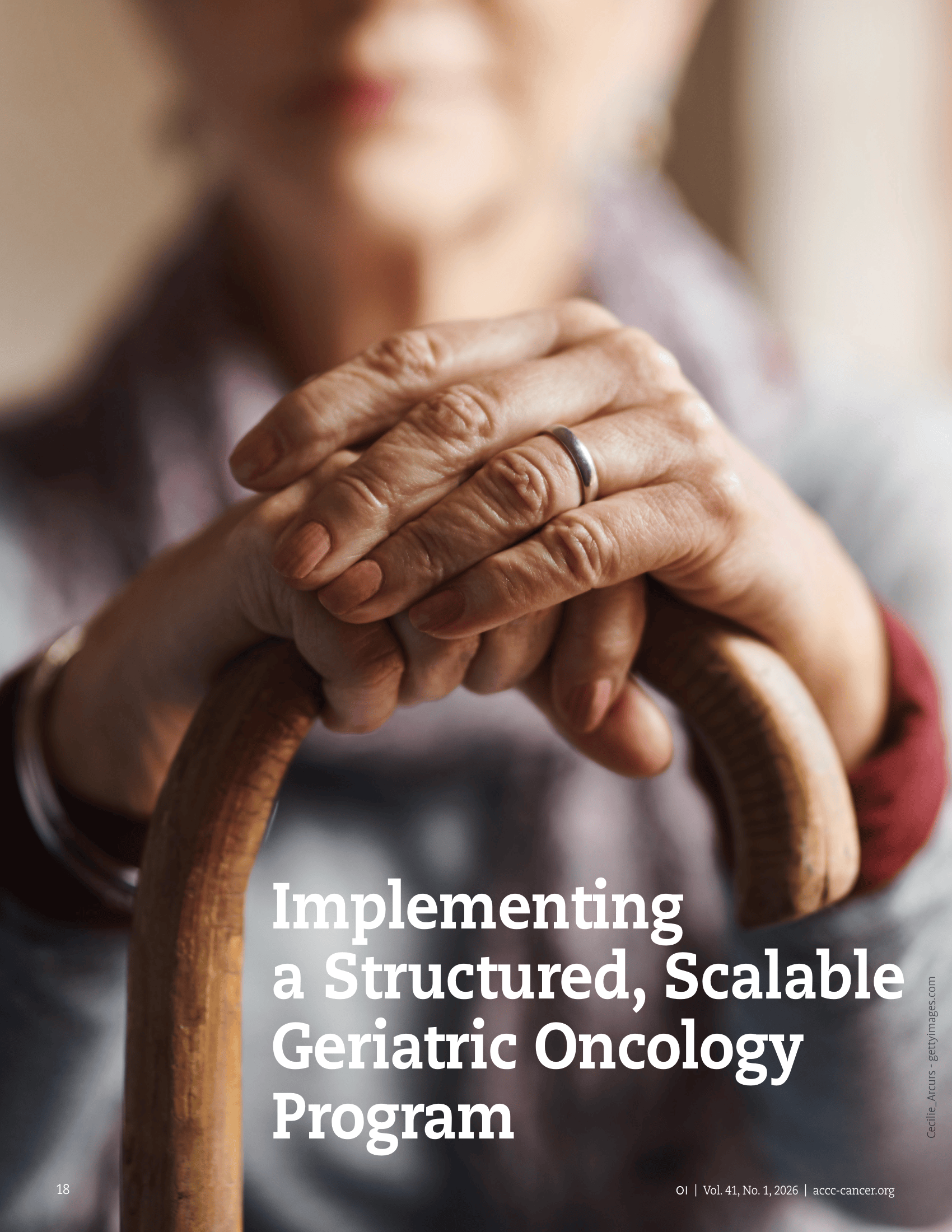
Implementing a Structured, Scalable Geriatric Oncology ProgramOncology Issue

Implementing a Structured, Scalable Geriatric Oncology Program

Ramy Sedhom, MD; Julianna Ani, MPH

February 16, 2026

Recognizing Innovation in Cancer PreventionACCCBuzz Blog

Recognizing Innovation in Cancer Prevention

Gabrielle Stearns

February 12, 2026

Upcoming Events

ACCC Leadership Summit
Oncology

ACCC Leadership Summit

In Person Meeting & NetworkingApril 16, 2026 at 8:00 AM EDT
Express Interest Now!
ACCC Oncology Reimbursement Meeting | Charleston
Oncology

ACCC Oncology Reimbursement Meeting | Charleston

In Person Meeting & NetworkingMay 6, 2026 at 8:00 AM EDT560 King Street, Charleston, SC, USAHyatt Place + Hyatt House Charleston - Historic District, Charleston
Register Now!
ACCC Oncology Reimbursement Meeting | St. Louis
Oncology

ACCC Oncology Reimbursement Meeting | St. Louis

In Person Meeting & NetworkingMay 13, 2026 at 8:00 AM CDT1335 South Lindbergh Boulevard, St. Louis, MO, USAHilton St. Louis Frontenac, St. Louis
Register Now!
ACCC 43rd National Oncology Conference
Oncology

ACCC 43rd National Oncology Conference

In Person Conference & ConventionOctober 21, 2026 at 8:00 AM MDT450 Summer St, Boston, MA 02210Omni Boston Hotel at the Seaport, Boston
Register Now!
COS 2026 Dinner Symposium - Grand Junction
Oncology

COS 2026 Dinner Symposium - Grand Junction

In Person Conference & ConventionApril 9, 2026 at 5:30 PM MDT840 Kennedy Avenue, Grand Junction, CO, USADevil's Kitchen, Grand Junction
Register Now!
TOPS 2026 Annual Conference
Oncology

TOPS 2026 Annual Conference

In Person Conference & ConventionApril 11, 2026 at 7:00 AM CDT201 8th Avenue South, Nashville, TN 37203, USAJW Marriott Nashville, Nashville
Register Now!
MSCO 2026 Spring Conference
Oncology

MSCO 2026 Spring Conference

In Person Conference & ConventionApril 15, 2026 at 5:00 PM CDTPark Pl Blvd, St. Louis Park, MN, USADoubleTree by Hilton Hotel Minneapolis - Park Place, St. Louis Park
Register Now!
KaSCO 2026 Spring Dinner Symposium
Oncology

KaSCO 2026 Spring Dinner Symposium

In Person Conference & ConventionApril 15, 2026 at 6:00 PM CDT101 W 22nd St, Kansas City, MO, USALidia's Kansas City, Kansas City
Register Now!
WVOS 2026 Spring Conference
Oncology

WVOS 2026 Spring Conference

In Person Conference & ConventionApril 16, 2026 at 8:00 AM EDT200 Lee Street East, Charleston, WV, USACharleston Marriott Town Center, Charleston
Register Now!
DOS 2026 Spring Conference
Oncology

DOS 2026 Spring Conference

In Person Conference & ConventionApril 16, 2026 at 5:30 PM CDT215 Broadway North, Fargo, ND 58102, USAJasper Hotel, Fargo
Register Now!
KYSCO 2026 Immunotherapy Meeting
Oncology

KYSCO 2026 Immunotherapy Meeting

In Person Conference & ConventionApril 18, 2026 at 7:30 AM EDT4174 Rowan, Lexington, KY, USAOrigin Lexington, a Wyndham Hotel, Lexington
Register Now!
Advertisement
Advertisement

Trending Now on
ACCCBuzz Blog

Representing Veterans in Clinical Trials Through Public-Private Partnerships: A Q&A With NAVREF

Representing Veterans in Clinical Trials Through Public-Private Partnerships: A Q&A With NAVREF

ACCCBuzz interviewed leadership from the National Association of Veterans’ Research and Education Foundations to better understand the current clinical and operational barriers Veterans face in accessing clinical trials and the progress being made to address them.

Confronting a Lethal Cancer: Duke Launches Multidisciplinary Pancreatic Cancer Center for Earlier Detection and Better Outcomes

Confronting a Lethal Cancer: Duke Launches Multidisciplinary Pancreatic Cancer Center for Earlier Detection and Better Outcomes

In an effort to improve outcomes and deliver the highest quality of care to patients with pancreatic cancer, Duke Cancer Institute launched a multidisciplinary Pancreatic Cancer Center that prioritizes thorough surveillance of high-risk patients, stays at the forefront of clinical trials, and considers the role of comorbidities.

From Hospital to Home: A Solution for Proactive Symptom Monitoring and Precise Care

From Hospital to Home: A Solution for Proactive Symptom Monitoring and Precise Care

Electronic patient-reported outcomes (ePROs) can address limited visibility into patients' health and well-being between visits. Yet, many solutions remain generic in their workflows and mainly help capture adverse events, without helping care teams proactively manage or prevent them from worsening. Cureety offers a new kind of ePRO solution, specialized in oncology and designed to make care better quality, more efficient, and more proactive for all patients.

A Candid Conversation About the Power of Early Palliative Care

A Candid Conversation About the Power of Early Palliative Care

In the latest episode of Oncology Unscripted, hosts Deirdre Saulet and Mark Liu sit down with Andrew Ambort, DO, a palliative care consulting physician whose work in reshaping the role of palliative care across oncology helped WellSpan Health win a 2025 ACCC Innovator Award.

View All ACCCBuzz Blogs

Recently Heard on
CANCER BUZZ Podcast

Transforming Palliative Care in Oncology – [Video Podcast] Ep. 227

Streamlining Access to TIL Cell Therapy for Melanoma

Policy in Practice: Change Hits the Clinic – [Podcast] Ep. 225

Addressing Psychosocial Distress With Psychedelic-Inspired Therapies – [Podcast] Ep. 224

View All Podcasts

Latest from Oncology Issues

February 2026
February 2026
December 2025
October 2025
August 2025
June 2025
View All Oncology Issues

Join the Conversation

ACCC eXchange Digital Banner
Login