ACCC association of cancer care centers
Join/Renew
Login
Join/Renew
Login
Education & Resources
ACCC eXchange LogInCorporate Member Sponsored ResourcesPresentations & AbstractsACCC Connect eLearning LogIn
Publications
Oncology IssuesPatient Assistance & Reimbursement GuideTrending Now in Cancer CareBusiness Case Studies for Hiring New Staff
Events
2026 ACCC Leadership SummitAnnual Meeting & Cancer Center Business SummitCapitol Hill DayNational Oncology ConferenceOncology Reimbursement MeetingsOncology State Society Meetings
Policy & Advocacy
2024 Policy Wrap-Up and ACCC 2025 Policy PrioritiesLetters & StatementsAccess, Payment & Reimbursement ReformWhite Bagging & Brown BaggingAdvocacy ResourcesCancer Moonshot
Membership
Join | RenewWho We AreMembership Types & BenefitsCorporate MembersACCC Member Portal FAQMember Directory
Partners
Oncology State SocietiesPartner OrganizationsCME
News
News ReleasesAdvocacy News ReleasesOncology News
About ACCC
Timeline / 50th Anniversary2025 Impact ReportPresident's ThemeACCC Innovator AwardsACCC FellowsBoard of TrusteesACCC Senior Staff
Breast CancerMetastatic Breast Cancer
Gastrointestinal CancerBiliary Tract CancerColorectal CancerGastric CancerLiver Cancer
Genitourinary CancerBladder CancerProstate CancerRenal Cell Carcinoma
Gynecologic CancerOvarian Cancer
Head & Neck Cancer
Hematologic MalignanciesAcute Lymphocytic Leukemia (ALL)Acute Myeloid Leukemia (AML)Chronic Lymphocytic Leukemia (CLL)Mantle Cell Lymphoma (MCL)Multiple Myeloma (MM)Myelodysplastic Syndromes (MDS)
Lung CancerNon-Small Cell Lung Cancer (NSCLC)Small Cell Lung Cancer (SCLC)
Sarcoma
Skin CancerMelanomaNon-Melanoma Skin Cancers (NMSC)
Clinical Practice & TreatmentCancer DiagnosticsCare CoordinationEHR Integration for Biomarker TestingQuality Improvement Collaboration: Integration of Precision Medicine in Community OncologyTreatment
Financial NavigationFAN Boot CampFinancial Advocacy Network (FAN) Resource LibraryPatient Assistance & Reimbursement GuidePrior Authorization
Health Equity & Access3, 2, 1, Go! Practical Solutions for Addressing Cancer Care DisparitiesAppalachian Community Cancer AllianceOncology Advanced PractitionersPersonalizing Care for Patients of All BackgroundsSocial Drivers of Health
Patient-Centered CareAddressing Care Disparities for VeteransAdolescent and Young Adult (AYA)Care Action Plans for People with CancerDermatologic ToxicitiesEmpowering CaregiversGeriatric OncologyHealth LiteracyNutritionOncology PharmacyPatient NavigationPsychosocial Care in OncologyShared Decision-MakingSupportive CareSurvivorship Care
Practice Management & OperationsCancer Program FundamentalsLeadership Sustainment and Engagement VideosOncology Practice Transformation and Integration CenterOncology Team Resiliency
ResearchACCC Community Oncology Research Institute (ACORI)
Technology & InnovationTelehealth & Digital Medicine
ACCCBuzz Blog
CANCER BUZZ Podcast
Oncology Issues
Join/Renew
Login
Breast CancerMetastatic Breast Cancer
Gastrointestinal CancerBiliary Tract CancerColorectal CancerGastric CancerLiver Cancer
Genitourinary CancerBladder CancerProstate CancerRenal Cell Carcinoma
Gynecologic CancerOvarian Cancer
Head & Neck Cancer
Hematologic MalignanciesAcute Lymphocytic Leukemia (ALL)Acute Myeloid Leukemia (AML)Chronic Lymphocytic Leukemia (CLL)Mantle Cell Lymphoma (MCL)Multiple Myeloma (MM)Myelodysplastic Syndromes (MDS)
Lung CancerNon-Small Cell Lung Cancer (NSCLC)Small Cell Lung Cancer (SCLC)
Sarcoma
Skin CancerMelanomaNon-Melanoma Skin Cancers (NMSC)
Clinical Practice & TreatmentCancer DiagnosticsCare CoordinationEHR Integration for Biomarker TestingQuality Improvement Collaboration: Integration of Precision Medicine in Community OncologyTreatment
Financial NavigationFAN Boot CampFinancial Advocacy Network (FAN) Resource LibraryPatient Assistance & Reimbursement GuidePrior Authorization
Health Equity & Access3, 2, 1, Go! Practical Solutions for Addressing Cancer Care DisparitiesAppalachian Community Cancer AllianceOncology Advanced PractitionersPersonalizing Care for Patients of All BackgroundsSocial Drivers of Health
Patient-Centered CareAddressing Care Disparities for VeteransAdolescent and Young Adult (AYA)Care Action Plans for People with CancerDermatologic ToxicitiesEmpowering CaregiversGeriatric OncologyHealth LiteracyNutritionOncology PharmacyPatient NavigationPsychosocial Care in OncologyShared Decision-MakingSupportive CareSurvivorship Care
Practice Management & OperationsCancer Program FundamentalsLeadership Sustainment and Engagement VideosOncology Practice Transformation and Integration CenterOncology Team Resiliency
ResearchACCC Community Oncology Research Institute (ACORI)
Technology & InnovationTelehealth & Digital Medicine
ACCCBuzz Blog
CANCER BUZZ Podcast
Oncology Issues
    • Education & Resources
    • Publications
    • Events
    • Policy & Advocacy
    • Membership
    • Partners
    • News
    • About ACCC
ACCC association of cancer care centers
1801 Research Boulevard, Suite 400, Rockville, MD 20850
Tel: 301.984.9496 Email Us
Contact UsVolunteers
Advertise
Career Center
Terms and Conditions
Privacy Policy
ACCC Rebranding
Copyright © 2026 Association of Cancer Care Centers. All Rights Reserved.
Home / Education And Resources / Cancer Types / Head Neck Cancer
Cancer Types
  • Breast Cancer
  • Gastrointestinal Cancer
  • Genitourinary Cancer
  • Gynecologic Cancer
  • Head & Neck Cancer
    • Advisory Committee
  • Hematologic Malignancies
  • Lung Cancer
  • Sarcoma
  • Skin Cancer

HEAD & NECK CANCER

Multidisciplinary Approaches to Head & Neck Cancer Care

Head and neck cancers account for approximately 4% of all cancers in the United States.1 Referred to collectively as head and neck cancers, these squamous cell carcinomas can develop in or around the mouth, throat (pharynx), voice box (larynx), nose, sinuses, and salivary glands—however mouth, throat, or voice box cancer are the most diagnosed among all head and neck cancers.1

As alcohol and tobacco use (including secondhand smoke and smokeless “chewing” tobacco) are two of the most common risk factors for development of head and neck cancers, there is often a stigma or shame associated with patients diagnosed with head and neck cancers, adding an additional layer of psychosocial distress for patients. However, head and neck cancers may also develop in nonsmokers, due to infection with human papillomavirus (HPV), occupational or industrial exposure to wood dust or other particles or fibers, radiation exposure, Epstein-Barr virus infection, ancestry, or other underlying genetic disorders.1 Patients with head and neck cancers may also experience significant challenges and distress associated with disease symptoms, difficulty eating, difficulty communicating, and other psychosocial factors that can reduce their quality of life.

If detected early, approximately 80% of individuals diagnosed with head and neck cancers can survive.2 Advances in treatment and a multimodal approach (that may include surgery, radiation therapy, systemic medical therapy with chemotherapy, targeted therapy, and/or immunotherapy) are improving outcomes, however access to therapies and effective multimodal care coordination remains a challenge.

Featured Resources

1/3

Landscape Analysis

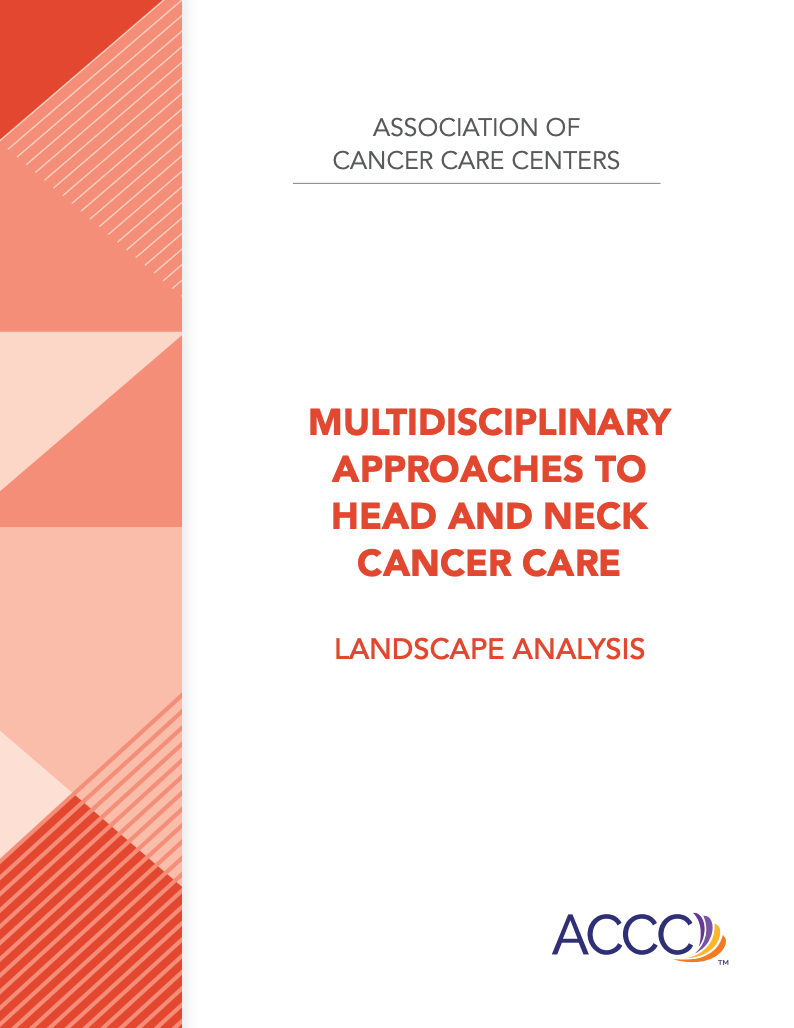
While recent advances in treatment are improving outcomes for patients with head and neck cancer, multidisciplinary care models and strategies to address psychosocial support for patients and caregivers can significantly improve care. ACCC explores current practices in clinical treatment of head and neck cancer and highlights effective approaches to utilizing multimodal care coordination across various practice settings.

Download
Landscape Analysis

From the ACCCBuzz Blog

Head and Neck Cancer: A Multidisciplinary Approach

Head and Neck Cancer: A Multidisciplinary Approach

April 18, 2025

In recognition of Head and Neck Cancer Awareness Month this April, ACCC urges health care professionals to actively engage in education efforts, champion screening initiatives, and address persistent disparities in access to head and neck cancer care.

Head and Neck Cancer: Understanding Gaps in Insurance Coverage

Head and Neck Cancer: Understanding Gaps in Insurance Coverage

April 26, 2024

In recognition of April as Head and Neck Cancer Awareness Month, ACCCBuzz analyzes insurance coverage for patients with head and neck cancers.

Lightbulb Idea_ACCCBuzz_Square

Preventing Head and Neck Cancers: The Importance of Oral Health Screenings

April 5, 2024

Vickie Yattaw, RN, OCN, oncology education and support services manager at the C.R. Wood Cancer Center, shares insights on a recent annual oral health screening event.

CANCER BUZZ Podcasts

Psychosocial Support in Head and Neck Cancer Care – [Podcast] Ep 163

September 12, 2024

In this episode, CANCER BUZZ speaks with Jacquelyn Doenges, LCSW, MSSW, CTTS, clinical oncology social worker at UT Southwestern Medical Center—Harold C. Simmons Comprehensive Cancer Center, and Linda Hutkin-Slade, MSW, LCSW, OSW-C, clinical oncology social worker at David & Donna Long Cancer Center—Sharp Grossmont Hospital, about providing optimal psychosocial support for this patient population.

Beyond the Brush: Navigating Dental Care in Head & Neck Cancer – [Podcast] Ep 149

April 2, 2024

While advancements in oral medicine are improving the treatment landscape for head and neck cancer, routine dental care and preventative oral cancer screenings can help identify head and neck cancers early. In this episode, Alessandro Villa, DDS, PhD, MPH, chief of Oral Medicine, Oral Oncology, and Dentistry at Baptist Health South Florida’s Miami Cancer Institute, emphasizes the proactive role dentists can play in early identification of cancer—as well as the need for equitable access to dental care—and explores how a cross-disciplinary cancer care team and patient education work in tandem to better manage complications from head and neck treatment.

Making the Case for Head & Neck Cancer Patient Care Navigators — [PODCAST] EP 143

February 21, 2024

Recent advancements in treatment and a multimodal approach to care are improving outcomes for patients with head and neck cancer, however access to therapies and unique patient challenges due to disease symptoms, difficulty eating, difficulty communicating, and other psychosocial factors can reduce patient quality of life.

Abstracts and Presentations

[Abstract] Perceived Barriers to Optimal Care in Head and Neck Cancer: A Mixed-Methods Study

November 14, 2024

Presented at Journal of the Advanced Practitioner in Oncology (JADPRO) Live 2024 in Grapevine, Texas.

[Abstract 6079 and Poster 394] Evaluating perceived barriers to optimal care in head and neck cancer: A mixed-methods study

June 19, 2024

This is a visual representation of an online publication from the American Society of Clinical Oncology 2024 Annual Meeting, May 31 – June 4, 2024.


Our Supporters

Emd Serono

Our Partners

Astro
Head & Neck Cancer Alliance

References

  1. Head and neck cancers. National Cancer Institute. Published June 9, 2021. Accessed September 21, 2023. https://www.cancer.gov/types/head-and-neck/head-neck-fact-sheet
  2. Home. Head and Neck Cancer Alliance. Published May 16, 2017. Accessed September 21, 2023. https://www.headandneck.org/