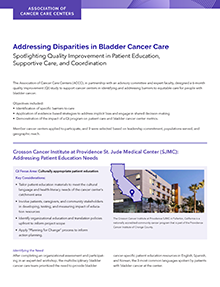
Bladder cancer is the 6th most common cancer in the US, yet significant disparities in access to guideline-concordant care persist—particularly among Black patients, women, older adults, uninsured individuals, and those in rural communities. For many patients with bladder cancer, access to personalized, high-quality care remains limited due to systemic inequities that impact timely diagnosis, treatment access, and use of supportive services. Overcoming these disparities requires data-driven strategies and a reimagining of care delivery grounded in equity.
ACCC provides resources to support cancer care professionals in identifying and addressing barriers to guideline-concordant care, helping ensure all patients receive equitable, evidence-based treatment.
Navigate the growing complexity of bladder cancer care using a framework for best practices developed by ACCC and the Bladder Cancer Advocacy Network (BCAN). Qualifying cancer programs/practices may join a public registry on BCAN.org.

Each May, Bladder Cancer Awareness Month helps highlight the facts about bladder cancer, promote awareness about the disease, and call for more investment in research, treatment, and care. This year’s theme emphasizes the importance promoting conversations about bladder cancer and its symptoms, treatments, and management.
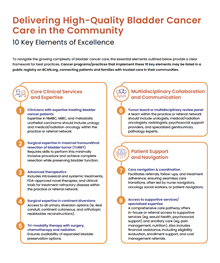
Navigating the growing complexity of bladder cancer care is essential to improving patient access and treatment closer to home. In this episode, CANCER BUZZ speaks with Suzanne Merrill, MD, urologic oncologist at Colorado Urology about barriers and solutions to delivering high-quality bladder cancer care in community settings. CANCER BUZZ also speaks with Patrick Hensley, MD, urologist at University of Kentucky Markey Cancer Center, about implementing the Delivering High-Quality Bladder Cancer Care infographic in the community setting. Created by ACCC and BCAN, the infographic describes the 10 elements of excellent bladder cancer care. Cancer programs that align their practices with these guidelines can join a public registry so that patients and caregivers can identify quality bladder cancer care close to where they live.
Disparities in bladder cancer care persist, especially with respect to race. In fact, patient demographics has a proven impact on health outcomes. Listen in as CancerBuzz speaks to Mary W. Dunn, MSN, RN, OCN, NP-C, Adult Nurse Practitioner of Urology and Medical Oncology at the UNC Lineberger Comprehensive Cancer Center and Samuel L. Washington III, MD, MAS, Assistant Professor of Urology at the University of California, San Francisco, about health literacy, shared decision-making, and educational resources being developed by ACCC.
Bladder cancer remains a prevalent disease with significant disparities in care, particularly in underserved populations. To address this, ACCC launched a national quality improvement initiative in three phases: 1. assessment and preparation, 2. action plan implementation, and 3. monitoring for continuous improvement. Dr. Samuel Washington, from the University of California, San Francisco, discussed the initiative’s early findings, highlighting site-specific approaches.
This is a visual representation of an online publication from the American Society of Clinical Oncology 2022 Annual Meeting, June 3 - 7, 2022.