ACCC association of cancer care centers
Join/Renew
Login
Join/Renew
Login
Education & Resources
ACCC eXchange LogInCorporate Member Sponsored ResourcesPresentations & AbstractsACCC Connect eLearning LogIn
Publications
Oncology IssuesPatient Assistance & Reimbursement GuideTrending Now in Cancer CareBusiness Case Studies for Hiring New Staff
Events
2026 ACCC Leadership SummitAnnual Meeting & Cancer Center Business SummitCapitol Hill DayNational Oncology ConferenceOncology Reimbursement MeetingsOncology State Society Meetings
Policy & Advocacy
2024 Policy Wrap-Up and ACCC 2025 Policy PrioritiesLetters & StatementsAccess, Payment & Reimbursement ReformWhite Bagging & Brown BaggingAdvocacy ResourcesCancer Moonshot
Membership
Join | RenewWho We AreMembership Types & BenefitsCorporate MembersACCC Member Portal FAQMember Directory
Partners
Oncology State SocietiesPartner OrganizationsCME
News
News ReleasesAdvocacy News ReleasesOncology News
About ACCC
Timeline / 50th Anniversary2025 Impact ReportPresident's ThemeACCC Innovator AwardsACCC FellowsBoard of TrusteesACCC Senior Staff
Breast CancerMetastatic Breast Cancer
Gastrointestinal CancerBiliary Tract CancerColorectal CancerGastric CancerLiver Cancer
Genitourinary CancerBladder CancerProstate CancerRenal Cell Carcinoma
Gynecologic CancerOvarian Cancer
Head & Neck Cancer
Hematologic MalignanciesAcute Lymphocytic Leukemia (ALL)Acute Myeloid Leukemia (AML)Chronic Lymphocytic Leukemia (CLL)Mantle Cell Lymphoma (MCL)Multiple Myeloma (MM)Myelodysplastic Syndromes (MDS)
Lung CancerNon-Small Cell Lung Cancer (NSCLC)Small Cell Lung Cancer (SCLC)
Sarcoma
Skin CancerMelanomaNon-Melanoma Skin Cancers (NMSC)
Clinical Practice & TreatmentCancer DiagnosticsCare CoordinationEHR Integration for Biomarker TestingQuality Improvement Collaboration: Integration of Precision Medicine in Community OncologyTreatment
Financial NavigationFAN Boot CampFinancial Advocacy Network (FAN) Resource LibraryPatient Assistance & Reimbursement GuidePrior Authorization
Health Equity & Access3, 2, 1, Go! Practical Solutions for Addressing Cancer Care DisparitiesAppalachian Community Cancer AllianceOncology Advanced PractitionersPersonalizing Care for Patients of All BackgroundsSocial Drivers of Health
Patient-Centered CareAddressing Care Disparities for VeteransAdolescent and Young Adult (AYA)Care Action Plans for People with CancerDermatologic ToxicitiesEmpowering CaregiversGeriatric OncologyHealth LiteracyNutritionOncology PharmacyPatient NavigationPsychosocial Care in OncologyShared Decision-MakingSupportive CareSurvivorship Care
Practice Management & OperationsCancer Program FundamentalsLeadership Sustainment and Engagement VideosOncology Practice Transformation and Integration CenterOncology Team Resiliency
ResearchACCC Community Oncology Research Institute (ACORI)
Technology & InnovationTelehealth & Digital Medicine
ACCCBuzz Blog
CANCER BUZZ Podcast
Oncology Issues
Join/Renew
Login
Breast CancerMetastatic Breast Cancer
Gastrointestinal CancerBiliary Tract CancerColorectal CancerGastric CancerLiver Cancer
Genitourinary CancerBladder CancerProstate CancerRenal Cell Carcinoma
Gynecologic CancerOvarian Cancer
Head & Neck Cancer
Hematologic MalignanciesAcute Lymphocytic Leukemia (ALL)Acute Myeloid Leukemia (AML)Chronic Lymphocytic Leukemia (CLL)Mantle Cell Lymphoma (MCL)Multiple Myeloma (MM)Myelodysplastic Syndromes (MDS)
Lung CancerNon-Small Cell Lung Cancer (NSCLC)Small Cell Lung Cancer (SCLC)
Sarcoma
Skin CancerMelanomaNon-Melanoma Skin Cancers (NMSC)
Clinical Practice & TreatmentCancer DiagnosticsCare CoordinationEHR Integration for Biomarker TestingQuality Improvement Collaboration: Integration of Precision Medicine in Community OncologyTreatment
Financial NavigationFAN Boot CampFinancial Advocacy Network (FAN) Resource LibraryPatient Assistance & Reimbursement GuidePrior Authorization
Health Equity & Access3, 2, 1, Go! Practical Solutions for Addressing Cancer Care DisparitiesAppalachian Community Cancer AllianceOncology Advanced PractitionersPersonalizing Care for Patients of All BackgroundsSocial Drivers of Health
Patient-Centered CareAddressing Care Disparities for VeteransAdolescent and Young Adult (AYA)Care Action Plans for People with CancerDermatologic ToxicitiesEmpowering CaregiversGeriatric OncologyHealth LiteracyNutritionOncology PharmacyPatient NavigationPsychosocial Care in OncologyShared Decision-MakingSupportive CareSurvivorship Care
Practice Management & OperationsCancer Program FundamentalsLeadership Sustainment and Engagement VideosOncology Practice Transformation and Integration CenterOncology Team Resiliency
ResearchACCC Community Oncology Research Institute (ACORI)
Technology & InnovationTelehealth & Digital Medicine
ACCCBuzz Blog
CANCER BUZZ Podcast
Oncology Issues
    • Education & Resources
    • Publications
    • Events
    • Policy & Advocacy
    • Membership
    • Partners
    • News
    • About ACCC
ACCC association of cancer care centers
1801 Research Boulevard, Suite 400, Rockville, MD 20850
Tel: 301.984.9496 Fax: 301.770.1949 Email Us
Contact UsVolunteers
Advertise
Career Center
Terms and Conditions
Privacy Policy
ACCC Rebranding
Copyright © 2026 Association of Cancer Care Centers. All Rights Reserved.
HomeACCCBuzz Blog

Burnout in Oncology: Results from ACCC’s 2022 Mini Z Survey

November 8, 2022
By Barbara Schmidtman, PhD

Dr. Barbara Schmidtman highlights key findings from the 2022 ACCC Mini Z burnout survey, comparing results from the pre-pandemic 2019 to now.

Burnout in Oncology: Results from ACCC’s 2022 Mini Z Survey

In her monthly leadership series, Dr. Barbara Schmidtman—vice president of cancer health operations at Corewell Health West—offers her perspective on addressing workforce-related issues through effective leadership practices. Find all her posts in this blog series on the ACCC website.

Last month, I had the privilege of representing the ACCC Oncology Workforce Subcommittee at the 39th National Oncology Conference—hosted in West Palm Beach, Fla., from Oct. 12 to 14—and speak about findings from the association’s 2022 Mini Z burnout survey, which was also conducted in 2019.

For those of you who are unfamiliar with the Mini Z burnout survey, it is a statistically validated tool that measures burnout in healthcare professionals. Originally the tool was utilized to measure burnout among physicians, but, as time has progressed and the implications of burnout have been further explored, it has also been validated for use with other healthcare professionals, including advanced practice providers (APPs). The survey asks a series of questions that focus on outcomes and drivers of burnout, such as job satisfaction, stress, workplace atmosphere, workload, electronic health record (EHR) proficiency, and time spent in the EHR at home, including a qualitative question to understand how each individual defines burnout via a series of five pre-constructed answers—determining the extent to which an individual is burned out or not.

We know that burnout in the oncology profession is real, considering a lot of literature on healthcare burnout existed prior to the COVID-19 pandemic due to the complex nature of our work. We must deliver difficult news to patients and their families, provide complex treatments, deal with various payer rules that seem to continuously change, and, ultimately, deal with death—sometimes we watch patients, who we have grown to love, pass away. In conducting the Mini Z survey in 2022, ACCC’s intention was to measure levels of stress and burnout across all the oncology professionals that make up the multidisciplinary cancer care team for the first time, as well as to compare results from these professionals between 2019 and now.

Comparing Results: 2019 to Now

There were some limitations that I’d like to note when looking at the Mini Z results comparison from 2019 to 2022. The first was the number of participants; this number drastically dropped in 2022. There were 327 participants in 2019, whereas, in 2022, only 118 people participated in the survey. This alone could speak to a potential indication of healthcare burnout—less people felt compelled to participate in the survey or were simply too burned out to open the email. The other notable limitation is that there could be a variation in who answered the survey in 2019 versus 2022. Despite accounting for the same types of roles, the response population could be different each time.

Various healthcare professionals across the cancer care continuum were surveyed, including nurse practitioners, physicians, administrators, social workers/financial advocates (e.g., counselors and navigators), and other, which included pharmacists, nutritionists/dieticians, researchers, data managers, tumor registry staff, and more.

There was a lot of data to compare, and I tried to keep the analysis simple. To do so, I created a heat map to articulate the level of change or no change from 2019 to 2022. Yellow indicates that there was no change, red means there is increase in burnout, and green shows there was an improvement in burnout rates from 2019 to 2022 (see figure below).

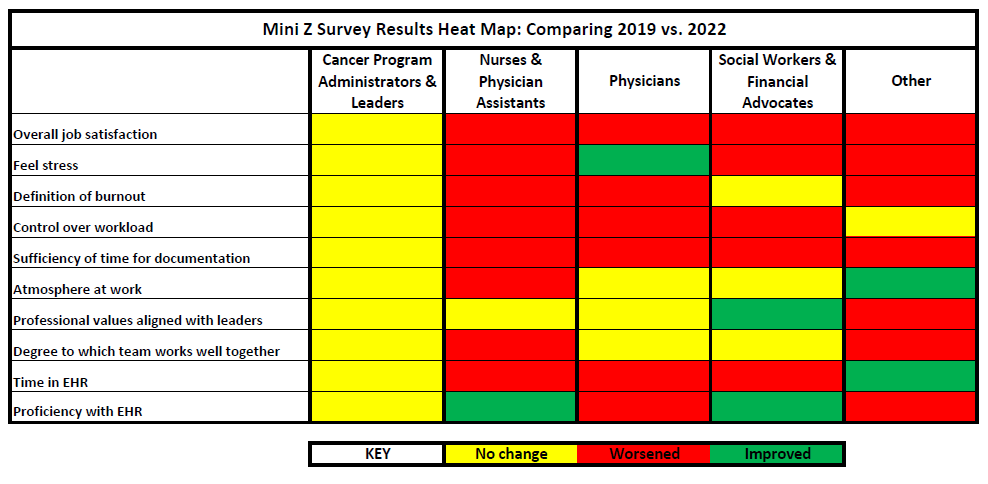
Overall, among cancer program administrators and practice managers, there was no significant change in outcomes and indicators of burnout. If one were to speculate, you could argue that administrators love solving complex problems, and, perhaps, the pandemic had no effect on their overall perception of burnout. Further, the two most at-risk groups are—and have historically been—APPs and physicians.

Nurses and Physician Assistants

Results from the 2022 Mini Z show that for the outcome indicators of burnout (feeling stress, job satisfaction, defining burnout) nurses and physician assistants are worse now than in 2019. Survey results also show that the drivers of this increased burnout were a lack of control over work, insufficiency of time for documentation, negative workplace atmosphere, and teams not working well together. The one driver that did improve in this group was proficiency with the EHR.

Physicians

As previously noted, physicians have significant changes in their burnout outcomes and driver indicators compared to three years ago, although these changes are not as bad as what is observed in the nurse/physician assistant group. The physician data indicates that job satisfaction and feelings of burnout are, in fact, worse now than in 2019. However, the outcome indicator for burnout—feeling stressed—has improved within this group. Physicians also show no change in perception of their workplace atmosphere, alignment of their professional values with leadership, and the degree to which their teams work well together. Feelings toward time spent in the EHR, as well as EHR proficiency, are worse than 2019 survey results. This could likely be due to the complexities associated with EHR use and requirements for documentation, contributing to physician burnout.

Social Workers and Financial Advocates

For the social worker/financial advocate group, there is little change in the definition of burnout when compared to 2019 survey results. However, there is change related to job satisfaction and overall feelings of stress. Feelings about workloads and time for documentation are worsening, yet value alignment with leadership is improving. This group is the only one that shows a notable improvement in overall value alignment with leadership.

Other

The last category—including all the other healthcare professionals on the multidisciplinary cancer care team—saw job satisfaction, feelings of stress, and burnout rates worsen in 2022 when compared to 2019. Other drivers for burnout include the insufficiency of time for documentation and overall lack of proficiency with the EHR. Another interesting find: this group is the only one that saw a reduction in value alignment with leadership, meaning that this has worsened since the last survey in 2019.

What Can We Do to Combat Burnout?

As part of this survey, we also asked participants whether their cancer program or practice has taken any action or implemented any solutions to help mitigate staff burnout and promote resiliency. Among all survey participants, only about one-quarter answered in the affirmative. Another 18 percent were unsure if their program or practice had taken any steps to promote staff resiliency, and more than half responded that their program or practice had not. While all of our programs and practices likely understand the detrimental impact that burnout has on our care teams, it seems that relatively few of us know where to begin to tackle this complex problem.

I wrote about burnout and taking care of ourselves in one of my first blogs. It is so important that when we reflect on our team members who are at higher risk of burnout, we understand what is impacting their ability to find joy in the workplace and reduce job-related stress. Aside from the things that we have control over, being a strong advocate for and implementing recognition programs, good leadership, and time for clinical documentation and performing administrative tasks are just a few ways we can help our care teams improve on the key drivers of burnout measured in this survey.

Barbara Schmidtman, PhD, has worked in healthcare for more than 20 years in a variety of professional and clinical roles. Currently, she is the executive director of cancer health at Spectrum Health West Michigan in Grand Rapids. Dr. Schmidtman is the ACCC Workforce Subcommittee Chair, a subgroup of the association's Governmental Affairs Committee. Dr. Schmidtman earned her PhD in business administration from Northcentral University, where she specialized in industrial organizational psychology. Her doctoral studies focused on physician behaviors and how demonstrated physician leadership affects individuals and teams—either positively or negatively. Dr. Schmidtman has a passion for speaking locally and nationally on leadership styles and approaches.

Related Content

Confronting a Lethal Cancer: Duke Launches Multidisciplinary Pancreatic Cancer Center for Earlier Detection and Better OutcomesACCCBuzz Blog

Confronting a Lethal Cancer: Duke Launches Multidisciplinary Pancreatic Cancer Center for Earlier Detection and Better Outcomes

Rachel Radwan

March 25, 2026

From Hospital to Home: A Solution for Proactive Symptom Monitoring and Precise Care ACCCBuzz Blog

From Hospital to Home: A Solution for Proactive Symptom Monitoring and Precise Care

Rachel Radwan

March 23, 2026

A Candid Conversation About the Power of Early Palliative CareACCCBuzz Blog

A Candid Conversation About the Power of Early Palliative Care

Monique J. Marino

March 19, 2026

Rare but Real: Lessons From Providers Treating BPDCN and MCLACCCBuzz Blog

Rare but Real: Lessons From Providers Treating BPDCN and MCL

Rachel Radwan

February 27, 2026

Highlights From Volume 41, Number 1 Oncology IssuesACCCBuzz Blog

Highlights From Volume 41, Number 1 Oncology Issues

Gabrielle Stearns

February 18, 2026

Implementing a Structured, Scalable Geriatric Oncology ProgramOncology Issue

Implementing a Structured, Scalable Geriatric Oncology Program

Ramy Sedhom, MD; Julianna Ani, MPH

February 16, 2026

Recognizing Innovation in Cancer PreventionACCCBuzz Blog

Recognizing Innovation in Cancer Prevention

Gabrielle Stearns

February 12, 2026

3 Surprising Truths About Leading Through Change: Strategies for Oncology Leaders to Thrive in the AI EraACCCBuzz Blog

3 Surprising Truths About Leading Through Change: Strategies for Oncology Leaders to Thrive in the AI Era

Michelle Rozen, PhD

February 5, 2026

Upcoming Events

ACCC Leadership Summit
Oncology

ACCC Leadership Summit

In Person Meeting & NetworkingApril 16, 2026 at 8:00 AM EDT
Express Interest Now!
ACCC Oncology Reimbursement Meeting | Charleston
Oncology

ACCC Oncology Reimbursement Meeting | Charleston

In Person Meeting & NetworkingMay 6, 2026 at 8:00 AM EDT560 King Street, Charleston, SC, USAHyatt Place + Hyatt House Charleston - Historic District, Charleston
Register Now!
ACCC Oncology Reimbursement Meeting | St. Louis
Oncology

ACCC Oncology Reimbursement Meeting | St. Louis

In Person Meeting & NetworkingMay 13, 2026 at 8:00 AM CDT1335 South Lindbergh Boulevard, St. Louis, MO, USAHilton St. Louis Frontenac, St. Louis
Register Now!
ACCC 43rd National Oncology Conference
Oncology

ACCC 43rd National Oncology Conference

In Person Conference & ConventionOctober 21, 2026 at 8:00 AM MDT450 Summer St, Boston, MA 02210Omni Boston Hotel at the Seaport, Boston
Register Now!
 LOS 2026 Advocacy Summit
Oncology

LOS 2026 Advocacy Summit

In Person Conference & ConventionApril 1, 2026 at 5:00 PM CDT355 North Boulevard, Baton Rouge, Louisiana, USACity Club of Baton Rouge, Baton Rouge
Register Now!
COS 2026 Dinner Symposium - Grand Junction
Oncology

COS 2026 Dinner Symposium - Grand Junction

In Person Conference & ConventionApril 9, 2026 at 6:00 PM MDT840 Kennedy Avenue, Grand Junction, CO, USADevil's Kitchen, Grand Junction
Register Now!
TOPS 2026 Annual Conference
Oncology

TOPS 2026 Annual Conference

In Person Conference & ConventionApril 11, 2026 at 7:00 AM CDT201 8th Avenue South, Nashville, TN 37203, USAJW Marriott Nashville, Nashville
Register Now!
MSCO 2026 Spring Conference
Oncology

MSCO 2026 Spring Conference

In Person Conference & ConventionApril 15, 2026 at 5:00 PM CDTPark Pl Blvd, St. Louis Park, MN, USADoubleTree by Hilton Hotel Minneapolis - Park Place, St. Louis Park
Register Now!
KaSCO 2026 Spring Dinner Symposium
Oncology

KaSCO 2026 Spring Dinner Symposium

In Person Conference & ConventionApril 15, 2026 at 6:00 PM CDT101 W 22nd St, Kansas City, MO, USALidia's Kansas City, Kansas City
Register Now!
WVOS 2026 Spring Conference
Oncology

WVOS 2026 Spring Conference

In Person Conference & ConventionApril 16, 2026 at 8:00 AM EDT200 Lee Street East, Charleston, WV, USACharleston Marriott Town Center, Charleston
Register Now!
DOS 2026 Spring Conference
Oncology

DOS 2026 Spring Conference

In Person Conference & ConventionApril 16, 2026 at 5:30 PM CDT215 Broadway North, Fargo, ND 58102, USAJasper Hotel, Fargo
Register Now!
Advertisement
Advertisement

Trending Now on
ACCCBuzz Blog

Confronting a Lethal Cancer: Duke Launches Multidisciplinary Pancreatic Cancer Center for Earlier Detection and Better Outcomes

Confronting a Lethal Cancer: Duke Launches Multidisciplinary Pancreatic Cancer Center for Earlier Detection and Better Outcomes

In an effort to improve outcomes and deliver the highest quality of care to patients with pancreatic cancer, Duke Cancer Institute launched a multidisciplinary Pancreatic Cancer Center that prioritizes thorough surveillance of high-risk patients, stays at the forefront of clinical trials, and considers the role of comorbidities.

From Hospital to Home: A Solution for Proactive Symptom Monitoring and Precise Care

From Hospital to Home: A Solution for Proactive Symptom Monitoring and Precise Care

Electronic patient-reported outcomes (ePROs) can address limited visibility into patients' health and well-being between visits. Yet, many solutions remain generic in their workflows and mainly help capture adverse events, without helping care teams proactively manage or prevent them from worsening. Cureety offers a new kind of ePRO solution, specialized in oncology and designed to make care better quality, more efficient, and more proactive for all patients.

A Candid Conversation About the Power of Early Palliative Care

A Candid Conversation About the Power of Early Palliative Care

In the latest episode of Oncology Unscripted, hosts Deirdre Saulet and Mark Liu sit down with Andrew Ambort, DO, a palliative care consulting physician whose work in reshaping the role of palliative care across oncology helped WellSpan Health win a 2025 ACCC Innovator Award.

Rare but Real: Lessons From Providers Treating BPDCN and MCL

Rare but Real: Lessons From Providers Treating BPDCN and MCL

Patients with rare diseases and their families often feel isolated and overlooked, with many medical questions left unanswered and few people who can empathize with their condition. Rare Disease Day is observed globally each year to bring awareness for diseases and the people behind them by promoting the challenges these rare medical journeys pose for patients and caregivers.

View All ACCCBuzz Blogs

Recently Heard on
CANCER BUZZ Podcast

Transforming Palliative Care in Oncology – [Video Podcast] Ep. 227

Streamlining Access to TIL Cell Therapy for Melanoma

Policy in Practice: Change Hits the Clinic – [Podcast] Ep. 225

Addressing Psychosocial Distress With Psychedelic-Inspired Therapies – [Podcast] Ep. 224

View All Podcasts

Latest from Oncology Issues

February 2026
February 2026
December 2025
October 2025
August 2025
June 2025
View All Oncology Issues

Join the Conversation

ACCC eXchange Digital Banner
Login